Historical Performance Practice
Deepen your knowledge of the fundamentals of interpreting historical music on historical instruments and in singing, and express yourself in a historically informed and nuanced way in the solo and ensemble repertoire of the 17th to 19th centuries.
Study level
BA and MA
Coursework
15 credits
Teaching language
German / English
Start of studies
Every autumn and spring semester
Number of study places
Not limited
Course times
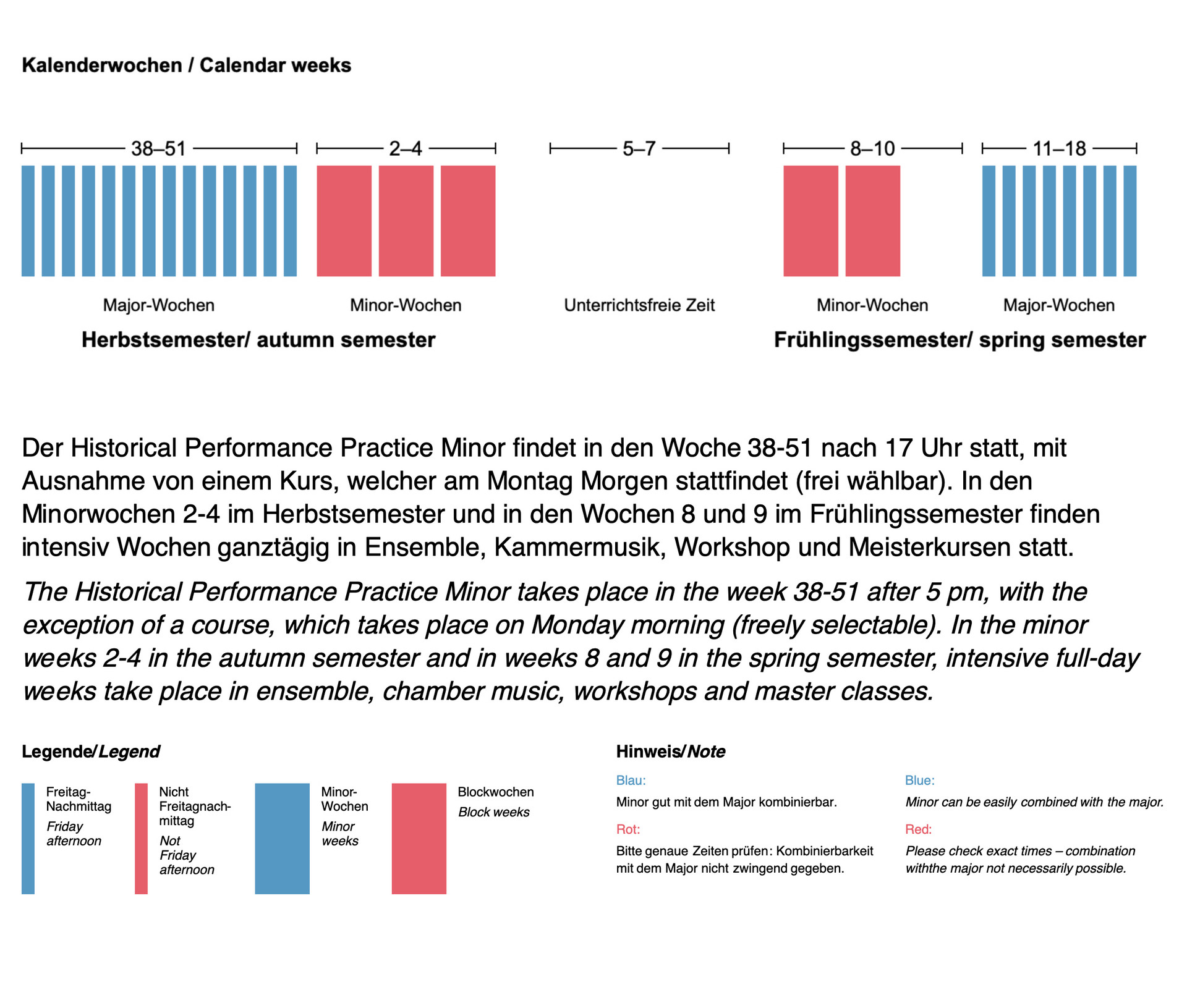
See time structure
Programme
Course content.
The Minor “Historical Performance Practice” deepens the fundamentals of the interpretation of historical music on historical instruments or in singing that originate from the Major. Aspects such as articulation, phrasing and ornamentation play just as important a role as stylistic differentiation by period and region. Students receive individual lessons on variant instruments or in singing, basic courses on the aspects of historically informed interpretation and performance of music (from Baroque to Romantic) as well as ensemble practice.
The minor in German and English is offered by the profile Interpretation & Performance. It is aimed at the Bachelor’s and Master’s degree levels.
Skills acquired in the course.
Graduates are well versed in specific historical sources, different styles and playing practices and can apply these in practice.
By dealing with the basics of historical performance practice, they are able to make independent interpretative decisions. They are able to express themselves in a historically informed and differentiated manner on the solo and ensemble repertoire of the 17th to 19th centuries.
Admissions requirements.
“Historical Performance Practice” is recommended for students with a practical connection to music before 1900 and a specific theoretical-historical interest. Prior mastery of a historical instrument is not necessarily required, but interest in it is expected. The minor is recommended for students with a major in brass instruments, voice, woodwind instruments, string instruments and keyboard instruments and from the Bachelor Music, Master Music Pedagogy, Master Music Performance and Master Specialized Music Performance degree programmes.
Language skills required.
You need the following languages to take this minor:
– German and English: to be able to follow a discussion
– German and English: to actively participate in a verbal exchange
– German and English: to understand a text
– German or English: to write a text
Benefits of studying at ZHdK.
With its numerous instrumental and vocal specialists, music theorists and researchers, ZHdK covers a broad spectrum in the field of historical performance practice. The study of early music takes place in a modern artistic environment and leads to a broader interdisciplinary understanding.
Time structure.
The Minor requires different time structures:
— Individual lessons (historical instrument):
are not bound to general time structures.
— Ensemble internship / chamber music internship / workshop / masterclasses:
The ensemble/chamber music internship takes place continuously during the semester and/or during the minor weeks, depending on the repertoire structure, project and objectives. During the minor weeks, master classes, workshops and practical ensemble/chamber music courses are also held with lecturers. Recital evenings take place during the semester and in the minor weeks.
— Historical performance practice:
The lesson is a part of the major and is expected to take place on Monday mornings.
— Ornamentation theory, historical improvisation, harmony theory/general bass, instrument-specific source studies, workshops:
take place cursorily and during the minor periods, evenings and Friday afternoons.
→ Semester dates ZHdK
→ More information about this minor (PDF download)
Time structure
Major-Minor Programme Model
At ZHdK, students choose a Major. In addition to this core subject, they can choose one or two Minors to deepen or expand their major skills and knowledge across various disciplines. This wide choice of courses is unique in Europe and enables students to develop and sharpen their individual profile.