Handwerk. The Principle of Craft – advanced
Exploring the workshop and its possibilities: craft techniques, constructive reflections and themes such as sustainability and economic efficiency are part of the minor and integrated in individually selected craft areas.
Study level
BA and MA
Coursework
15 credits
Teaching language
German
Start of studies
Autumn semester 2026
Number of study places
Limited
Course times
Minor weeks and Friday afternoons


Course
Course content
The Minor “Handwerk. The Principle of Craft” focuses on practical and theoretical questions relating to craftsmanship. Stories of regional and global craft techniques and their practitioners are explored and discussed from various perspectives, such as their historical, cultural and economic significance and their potential in the digital age. We use the tension between tradition and innovation for inspiration and design in order to responsibly address the divergence between sustainability and economic efficiency.
The Minor “Handwerk. The Principle of Craft – Advanced” starts in the autumn semester with inputs, presentations, basic practical exercises and visits to companies and exhibitions on topics such as (material) connections, surfaces (processing) or constructive questions and problems. The Minor Weeks in January and February enable additional transfer in external workshops and manufactories: For transfer and exchange of their own craft project interests, participants acquire further advanced skills in an internship. Within this framework, new perspectives and approaches to current and traditional manual processing techniques, production processes and the associated tools are opened up.
Skills acquired in the course
After completing the Minor,...
– participants will have theoretical and practical knowledge of handwork procedures and techniques as well as cultural practices in the context of handwork;
– participants will be able to work independently and confidently in workshops, and be familiar with the infrastructure;
– participants will be able to use machines, devices and tools appropriately and know how to maintain them;
– participants will be aware of the importance of using resources and materials sustainably as well as environmental topics connected with handwork.
Admissions requirements
When registering, students must confirm that they are enrolled in the minor “Handwerk. The Principle of Craft – Basic” or have completed this minor. Alternatively, relevant technical craft experience (e.g., apprenticeship as a carpenter, goldsmith/silversmith, locksmith, textile technician, etc.) may allow direct admission to the advanced minor. This must be declared in the application form.
Language skills required.
You need the following languages to take this minor:
– German: to be able to follow a discussion
– German: to actively participate in a verbal exchange
– German or English: to understand a text
– German: to write a text
Benefits of studying at ZHdK
The Minor offers participants the opportunity to extend their handwork interests and skills with expert support and a specific focus in mind.
As a follow-on from the “Handwerk. The Principle of Craft”, participants have the opportunity to concentrate and consolidate the practical work completed in the first year in advanced modules in the following year. We offer these advanced modules in an external workshop. In this way, students can acquire a total of 30 ECTS points with an individually tailored core subject of Handwork.
→ More about the Minor Handwerk. The Principle of Craft – advanced (PDF download)
Time structure
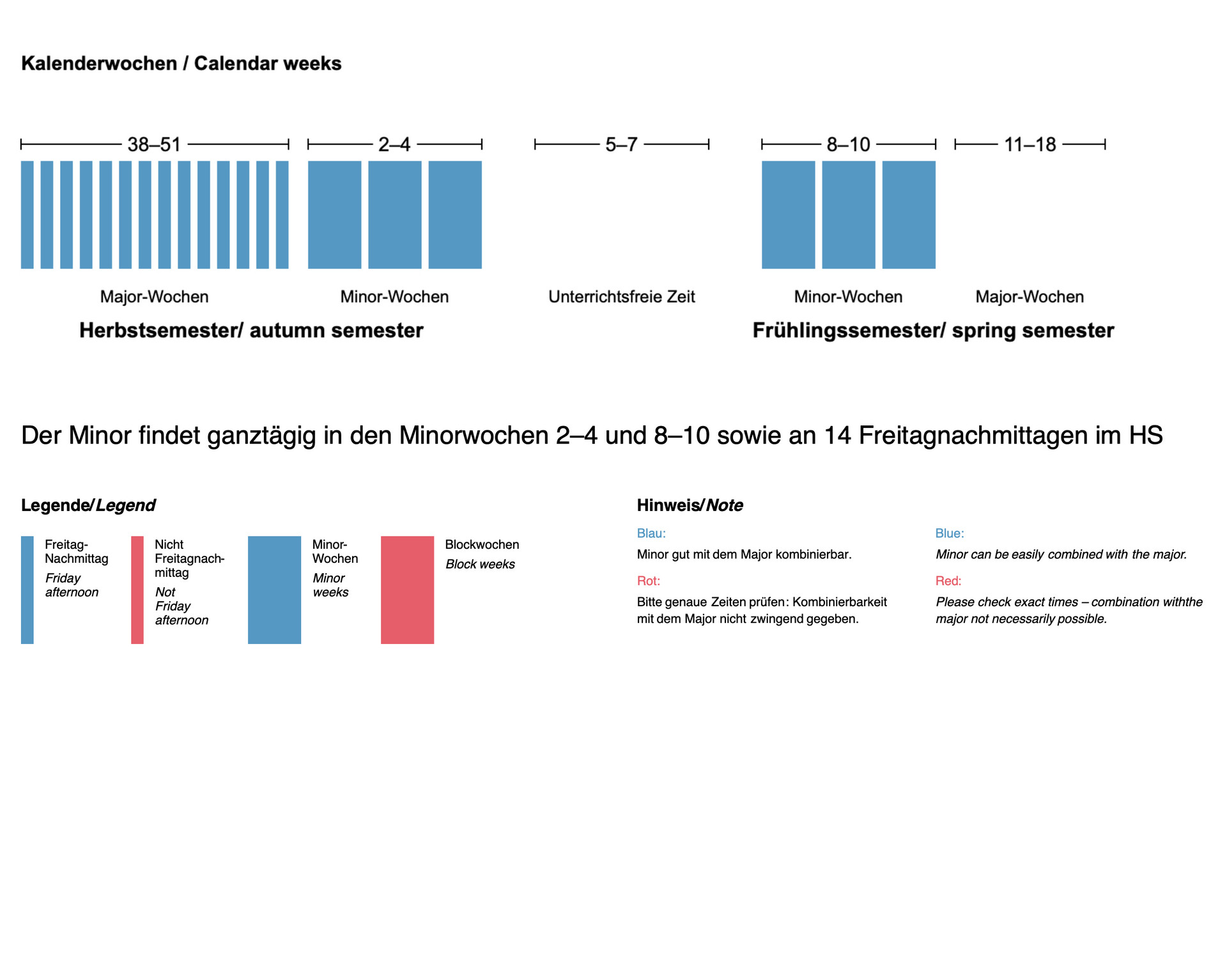
Major-Minor Programme Model
At ZHdK, students choose a Major. In addition to this core subject, they can choose one or two Minors to deepen or expand their major skills and knowledge across various disciplines. This wide choice of courses is unique in Europe and enables students to develop and sharpen their individual profile.