Diversity Politics and the Arts: Post-colonial Perspectives
In the minor Diversity Politics and the Arts: Post-colonial Perspectives, students develop a deep understanding for diversity from a post-colonial perspective and implement them in their own artistic projects. The cross-departmental minor is aimed at BA and MA students from all disciplines.
Study level
BA and MA
Coursework
15 credits
Teaching language
German / English
Start of studies
Every other autumn semester. Alternating with “Gender Perspectives”. Start of study cycle: Autumn semester 2026
Number of study places
Limited
Course times
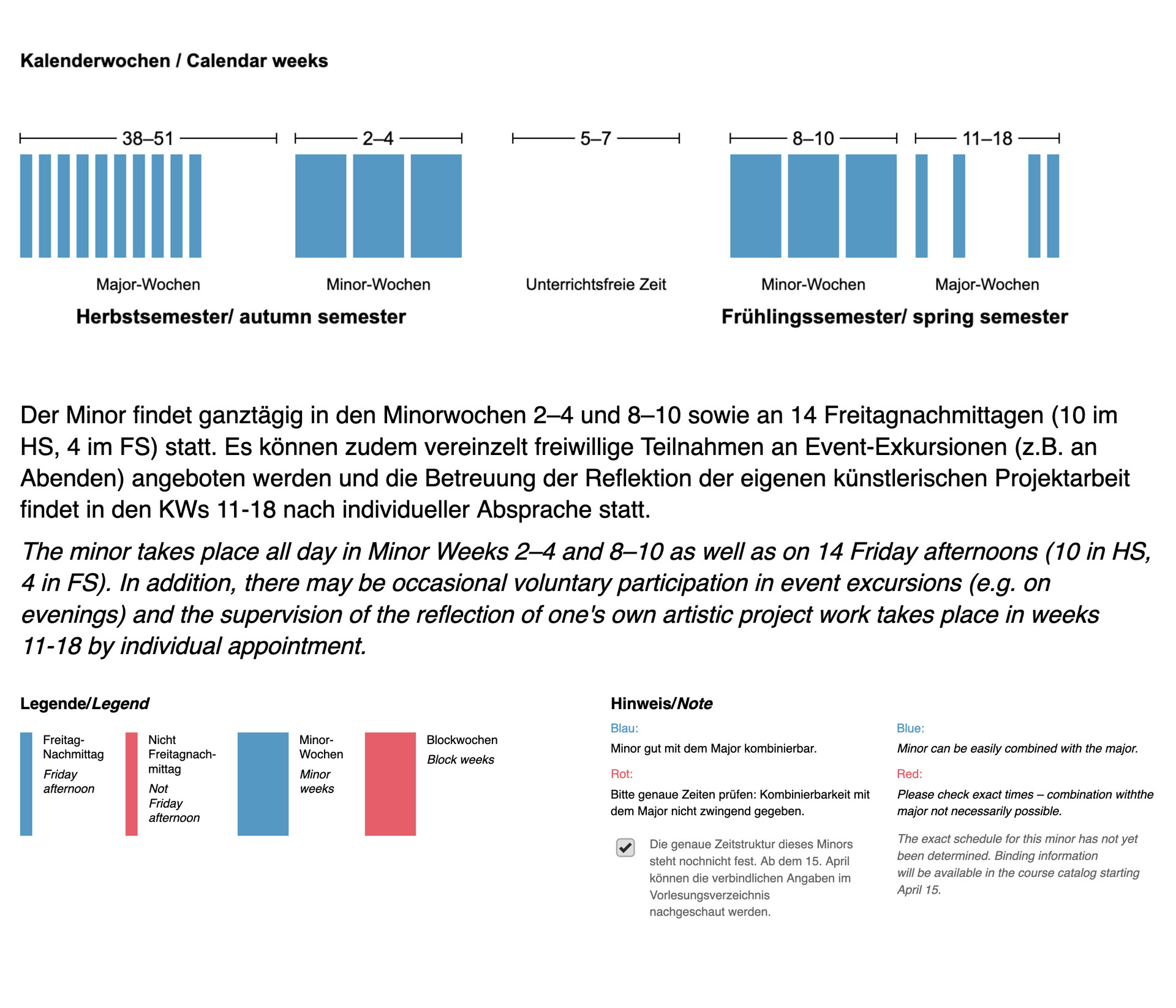
Minor weeks and Friday afternoons
Programme
Course content.
In the minor in Diversity Politics and the Arts: Post-colonial Perspectives, you will explore diversity in the arts from a post-colonial perspective. In doing so, you will learn to constantly consider the intersectional overlap with categories such as gender, religion, age and class. The focus of your minor studies is a critical examination of asymmetrical power relations and experiences of violence, which, as part of modern history, are inscribed in collective institutions as well as individual bodies and social forms. You will learn to recognise the entanglement of these historically grown hierarchical orders with discrimination and to relate them to your own practice. You will explore the question of how structures of discrimination can be challenged in artistic projects.
The Post-colonial Perspectives minor is offered alternately with the Gender Perspectives minor. The two minors are structured identically and pursue the same goals. By questioning power relations and discrimination from different perspectives, they enrich each other. Some lecturers teach in both minors. The two study programmes can be attended individually or consecutively.
Skills acquired in the course.
On completing this Minor, students will be able to
– understand how ideas, stereotypes, and attributions are interweaved with discrimination
– classify the role of postcolonial and anti-racist criticism
– position oneself in the arts, design, and education within postcolonial discourses and establish connections between different positions
– critically question social assumptions through dialogue, encounter, and sharing, and develop manners through artistic approaches
– assess spaces and situations by acquiring sensitivity in one's own artistic practice and productively apply this in organizations, institutions, and other work contexts (diversity skills)
Admissions requirements.
The minor Diversity Politics and the Arts: Post-colonial Perspectives is recommended for all ZHdK students.
Language skills required.
You need the following languages to take this minor:
– German or English: to be able to follow a discussion
– German or English: to actively participate in a verbal exchange
– German or English: to understand a text
– German or English: to write a text
Benefits of studying this minor.
You get input, space and time to explore the critique of Postcolonial Studies in the arts and to develop your own projects. In this way, you learn how theoretical and creative work are mutually dependent in the development of a postcolonial-informed artistic practice.
Time structure.
The minor takes place on Friday afternoons during the semester and as a full-day course during the minor weeks (week 2 to 4 and week 8 to 10).
→ Semester dates ZHdK
→ More information about this minor (PDF download)
Time structure
People
Minor Coordination


Major-Minor Programme Model
At ZHdK, students choose a Major. In addition to this core subject, they can choose one or two Minors to deepen or expand their major skills and knowledge across various disciplines. This wide choice of courses is unique in Europe and enables students to develop and sharpen their individual profile.